

A supervisor opens Thursday’s submissions. The GPS pin sits inside the right community. The survey length looks normal. Nothing in the file says anything is wrong.
But nobody in that review can hear what actually happened at the doorstep.
In 2017, a team of researchers, Gomila, Littman, Blair and Levy Paluck, built a method to close that exact gap. Enumerators recorded short audio snippets during real interviews. Reviewers listened back for the sounds of an actual household visit, a second voice, background noise, the natural pace of a real conversation.
In their Niger Delta field study, this one check flagged wholesale fabrication in 14% of surveys.
A GPS point alone would have called every one of those interviews a success.
How Audio Checks Catch Data Fabrication That GPS Misses
A GPS point tells you where a phone/ enumerators was. It says nothing about whether a respondent was actually sitting in front of it, or whether the enumerator sat under a tree and typed answers alone.
The protocol in Gomila et al. (2017) only required at least 8% of each surveyor’s interviews to be recorded. A modest sampling rate, lower than many back-check protocols. It was still enough to surface the finding.
Across the full pilot wave, reviewers worked through 1,880 audio files, split into subgroups of 1,102 and 778. Of those, 260 failed the check, 13.83% of the total, against 1,620 that passed. Every one of those 260 would have logged a correct GPS pin, a plausible completion time, a clean form.
The method worked because it checked the one thing a back-check and a location log cannot fake: the texture of an actual conversation.
Data Fabrication in Field Research Isn’t Just a Nigerian Problem
Fabrication shows up wherever nobody is listening closely, in any country running serious field volume.
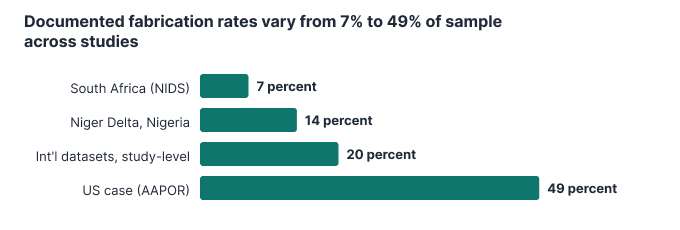
In South Africa’s National Income Dynamics Study, Finn and Ranchhod (2017) documented fieldworker fabrication affecting about 7% of the sample. When they costed out the investigation that caught it, they found a benefit-cost ratio of at least 24. The checking paid for itself more than twenty times over.
Look past Africa and the pattern holds. Kuriakose and Robbins reviewed 1,000 public international survey datasets and found roughly 20% showed fabrication at the study level. In the United States, AAPOR’s falsification task force documented a single case where six interviewers had falsified 49% of the 451 interviews they were assigned.
Seven percent in South Africa, fourteen in the Niger Delta, twenty across a thousand international datasets, forty-nine in one uncovered American case. Different countries, different survey types, different years. The rates move. The direction never does.
Why Back-Checks Alone Can’t Stop Data Fabrication in Nigeria
Nigerian survey protocols already lean on back-checks, and for good reason. A UNODC-supported public services survey in Nigeria used a 10% back check and 5% accompaniment nationally as its quality control. J-PAL’s current guidance recommends at least 10% of surveys or 40 per week, whichever is higher, for in-person work, with phone surveys set higher still. An earlier version of that same guidance put the in-person baseline at 10% to 15%.
A back-check re-contacts a sample of respondents after the fact. That only catches fabrication in the households chosen for re-check, and only if the respondent remembers the visit accurately.
An enumerator who picks a real household, knocks, confirms someone lives there, then invents the answers, can pass a GPS check cleanly. They can often pass a back-check too, if the re-check sample happens to miss them, or if the respondent only half-remembers what was asked. This is the structural reason the audio review in the Niger Delta surfaced cases that routine quality control was never built to catch.
How to Detect Data Fabrication: A Checklist for Nigerian Field Teams
Treat a correct GPS pin as necessary, not sufficient. It confirms where a device was. It does not confirm what happened in front of it.
Meet the J-PAL minimum on back-checks, at least 10% of surveys or 40 a week, whichever is higher. If you are running CATI or phone surveys, push past 10%.
If the budget allows it, add a modest audio-recording requirement. The Niger Delta study flagged 14% fabrication from a sampling rate as low as 8% per surveyor. You do not need to record everything to catch most of the problem.
Review flagged recordings while the field team is still in the area. A fabrication caught a week later cannot be fixed by sending the enumerator back. The respondent has moved on, the window has closed, and you are left re-collecting instead of correcting.
Track attrition across rounds, not just within one survey. Nigeria’s 2010-2011 GHS-Panel post-harvest round still needed replacement households for 17.9% of its sample, despite a 99.9% household response rate on the round itself. NBS’s GHS-Panel Wave 5 report puts overall attrition at 13.5% since 2010 across tracked enumeration areas. A single round can look clean while the panel underneath it is quietly thinning.
What the Data Fabrication Evidence Doesn’t Show
The 14% figure is one Niger Delta field study. It describes that study’s enumerator pool and its incentive structure at that time. It is not a national Nigerian rate, and it should not be quoted as one.
The study does not break down how much of that 14% was wholesale invention versus smaller shortcuts, beyond the pass and fail count in the audio file review.
The comparison figures, from South Africa, the international dataset review and the AAPOR case, come from different countries, different survey designs and different years. Read together they show that fabrication is a real and recurring risk in field research. They do not add up to one comparable global rate.
Catch Data Fabrication Before the Team Leaves the Field
A GPS pin and an audio flag both do their job better when somebody can act on them before the field closes, not after.
See how WeCollect’s field data collection platform records location and flags recordings for review while the enumerator is still on the ground, at demo.wecollect.tech.